Wardogs Cash Farming: The Fastest Ways to Make Money (2026)
The fastest reliable money in Wardogs is logistics: a $400 supply pallet can return roughly $3,900 delivered and unpacked. Here's every cash method ranked by what an hour of your time is actually worth.

The fastest reliable way to make money in Wardogs is logistics, not gunfights — a supply pallet costs $400, pays around $2,500 when delivered to the objective area, and adds another $1,800 once a teammate breaks it down at a FOB, which works out to roughly $3,900 of profit per pallet without firing a shot. Two pallets per truck, a five-minute round trip, and you have the most predictable income stream in the game.
The catch is that this is still driving a truck in circles for hours, and every Early Access patch can move the numbers underneath you. If you'd rather skip straight to fielding the kit, our Wardogs Cash farming servicefrom $8.49 puts a balance on your account while you go play the parts of the game you actually bought it for. Below is the full breakdown either way — what each method earns per hour, what it costs you, and where most players quietly lose money.
How the Wardogs cash engine actually works
Before ranking anything, understand the three rules that decide every payout.
1. Your balance is persistent, your loadout isn't. You start with $10,000, that balance follows you from match to match, and the kit you bought does not — die without a revive and the whole loadout is gone. The $10,000 is a one-time account grant, not a per-life payment, despite how often that gets repeated. A match is a ledger, not a scoreboard.
2. Location multiplies almost everything. A kill in the open is $300; the same kill is worth roughly $1,500 in the Control Zone and $3,000 in the Hot Zone — where you're standing matters more than what you did. The multiplier splits in half between where you stand and where the target falls, so shooting into the circle from outside still collects part of the bonus.
3. Server population scales your income. Every reward is multiplied by a factor set by the head count on the server: under ten players nothing pays at all, and the full rate needs around sixty — so a quiet server is a poor place to farm anything.
Pro tip: Before you commit to a farming session, check the server browser and join something close to full. The exact same pallet run on a half-empty server pays a fraction of the rate. This single habit is worth more than any loadout optimisation.
One honesty note: BULKHEAD has not published a complete Early Access table of cash per kill, revive, spot or delivery, so a number remembered from one beta should not become your budget. Several widely quoted payouts trace back to Closed Beta logs from a single source. Treat every figure here as a live-build estimate, not gospel.
Cash methods ranked, best to worst
- Ural pallet logistics. Highest profit per minute with the lowest death risk. The Ural is the ground pick because it carries two pallets per trip and unlocks early on the Driver track.
- Hot Zone transport (taxi runs). Launch-build measurements put Hot Zone transport at roughly $390 per passenger, about $1,000 when that passenger survives, and $1,500 per Hot Zone kill they score. Air is faster, ground is safer.
- The spawn APC. The M113 appears at HQ once a team reaches 20 points, pays roughly $3,000 for driving it into the combat area, and keeps generating money whenever teammates spawn on it — arguably the biggest single objective payout in the game, and most players never collect it.
- Builder-medic hybrid. Construction is quiet, safe money: every hammer swing on an unfinished structure pays, the yellow critical-build marker pays extra, and Hesco, wire and bastions all count. Stack revives on top and you earn on two tracks at once.
- Recon spotting. The best method when you're broke. Binoculars cost $75, a first tag pays 25 Recon XP and $100, and a teammate killing that live mark adds 150 Recon XP and $400. Assists on marks that die inside the Hot Zone can climb to $800–$1,600.
- Objective camping. Zone ticks pay on their own roughly every 24 seconds — about $160 per tick in the Control Zone and $320 in the Hot Zone, so around $400 and $800 a minute for holding ground. Decent passive income, terrible survival odds in an expensive kit.
- Pure combat with a premium loadout. Last place on purpose. A cheap loadout that survives longer usually earns more than an expensive kit that disappears after one death.
Worked example: one Ural round trip
Two pallets at $400 each = $800 out. Both delivered and unpacked = about $8,600 gross at reported payouts, against $800 of pallets and a $5,000 truck. Assume the truck survives and you reuse it: you're netting roughly $7,800 on a trip that takes five to seven minutes including the drive and the manual unload.
Even if only 60% of your pallets ever get unpacked by a teammate, that's still in the region of $50,000–$70,000 an hour on a full server. Nothing else in the game matches that consistency. For context on what that buys and how long the class tracks take, see our breakdown of how long leveling actually takes in Wardogs.
Pros and cons of running logistics
Pros
- Highest verified cash-per-minute of any method
- Almost no combat risk, so your kit budget stays near zero
- Feeds Driver XP (or Pilot XP by air) and Support XP while you earn
- Works at any account level once you have a truck
Cons
- The $1,800 unpack half depends entirely on teammates — prioritise FOBs your team is actually using, because that second payment only triggers when someone unpacks it
- Deeply repetitive; it is the least interesting thing in a 100-player war game
- Vehicle costs and unlock gates keep moving — the Ural got cheaper and earlier in Season 1 after previously sitting at $50,000 on Driver 4, and one live-build source lists it at $35,000 at Driver Level 3. Sources disagree on unlock fee versus per-spawn cost, so check your own vendor.
- Air delivery adds a failure mode: a pallet dropped from too high or too fast explodes, you still collect the delivery payment, but the $1,800 is gone
What you need before you start
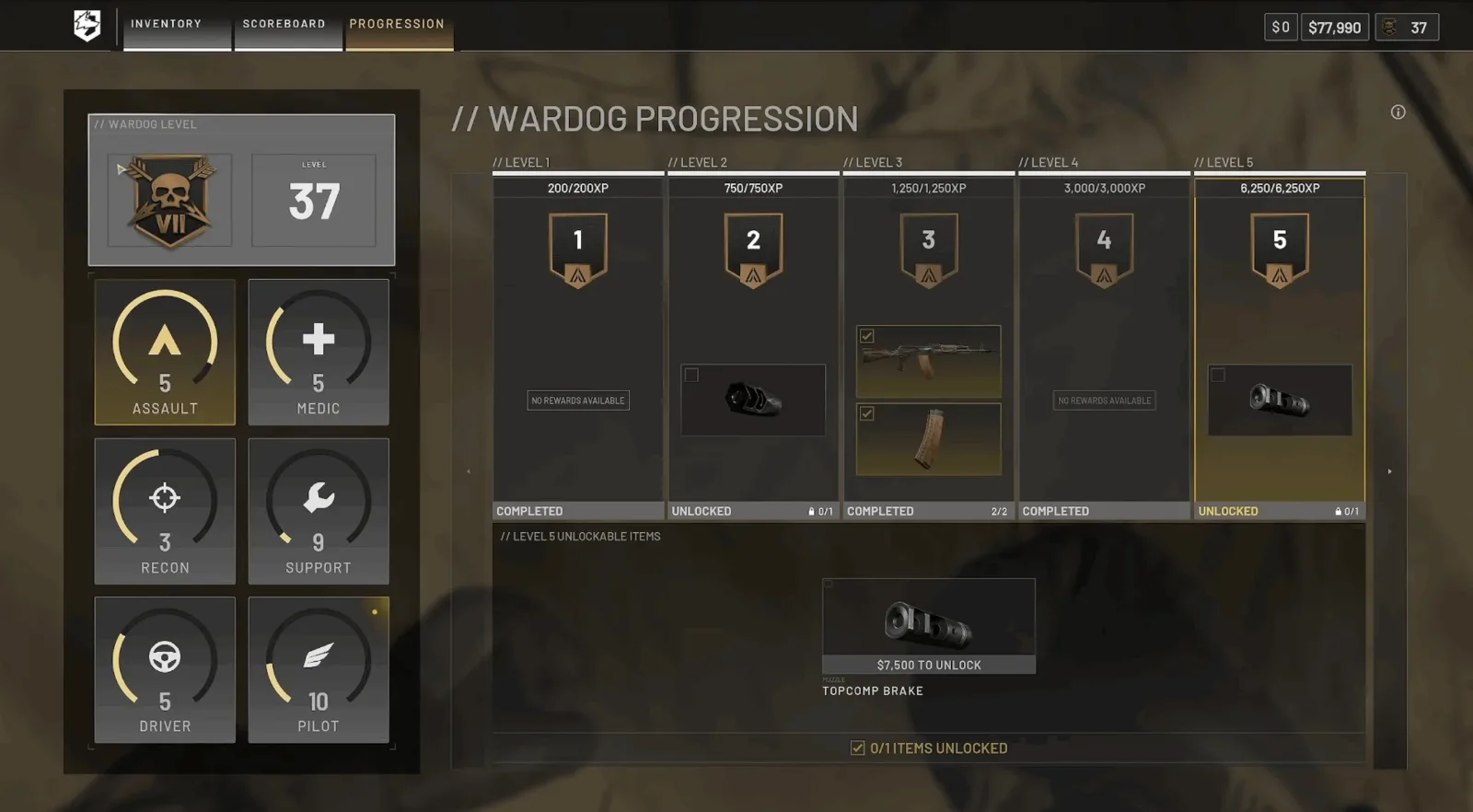
- A truck. Start with an SUV for early runs, then check the vehicle menu for the Ural at Driver level 3 so you can carry two pallets per trip. Unlocking it means leveling Driver, which is exactly what our vehicle unlock servicefrom $13.99 handles if you don't want to grind the track manually.
- A cheap earning kit. Binoculars at $75, a Small Hammer at $100, bandages at $200, and the free single-use Emergency Resuscitator cover spotting, building and revives for pocket change.
- The freebies. Always take the free Bushmaster rifle and your complimentary fast-revive resuscitator instead of buying a weapon you'll lose.
Common mistakes that cost you money
- Buying the fun gun first. The biggest mistake players make is spending too much cash on expensive gear before they have a reliable way to earn it back.
- Reading notifications instead of the ledger. Compare what you keep after expenses, not the individual reward popups.
- Farming far from the zone. A long-range perch feels safe, but it forfeits the multiplier that makes every action worth playing for.
- Chasing exploits. This is the expensive one. BULKHEAD's Patch 0.11 stance targets cash exploit and bug abuse with a timed ban plus a reset of your cash and XP to zero, and a permanent ban for tutorialising them. The studio's CEO has said publicly that two-account farming schemes earn very little, are visible to them, and will get you banned. If you're weighing up outside help instead, read our take on whether Wardogs boosting is safe in Early Access first.
Pro tip: Loot every body you walk past. Armor, ammo and medical items pulled off dead players cost nothing and cut your next respawn bill — cutting spend is mathematically identical to earning, and far less effort.
Method A vs method B vs buying: pick by player type
- New and broke: spotting with $75 binoculars. Zero risk, funds your first real kit in a couple of matches.
- Wants max cash, doesn't mind boredom: Ural logistics, full servers only.
- **Wants cash and fun:** builder-medic near the Hot Zone — you earn on revives, heals and construction while sitting where the multiplier is.
- Limited playtime: buying cash is the honest answer. If you have six hours a week, spending 15 of them driving a truck to afford a tank is a bad trade against a service that does the driving for you.
One timing caveat worth building into your plan: Wardogs runs on seasons, and the economy periodically resets to keep the meta fresh and stop veterans snowballing an unbeatable lead. Season 1 was confirmed as exactly one month long, and Season 02 was dated for 15 October 2026. Don't bank a fortune days before a wipe — see our Season 2 wipe breakdown for what carries and what doesn't.
Bottom line: Wardogs pays for usefulness, not for kills, and the multiplier on where you are useful is the whole game. Logistics into an active Hot Zone on a full server is the highest-yield loop available to a solo player, spotting is the best bootstrap, and expensive combat kits are a luxury you buy with logistics money — never the other way round.
Building a real war chest this way realistically means 10–20 hours of truck routes and hammer swings, most of it spent looking at scenery rather than the game you paid for. If you'd rather log in with the balance already sitting there, our Wardogs Cash farmingfrom $8.49 lets you pick the amount, the class we farm on, and how fast you need it.
Related Wardogs services
Vetted boosters handle the grind covered in this guide, with live support and scheduled delivery.
Wardogs Cash Farming
In-game Cash farmed on your account by a verified booster. Pick the amount, the class we farm on, and how fast you need it.
Wardogs Starter Bundle
All six class tracks levelled evenly plus a Cash balance to spend on the unlocks — one order, one booster, ready-to-play account.